
Reviewed · FREEDOM TRAIL WALKING TOURS
Walk the Historic Freedom Trail with Costumed Guide
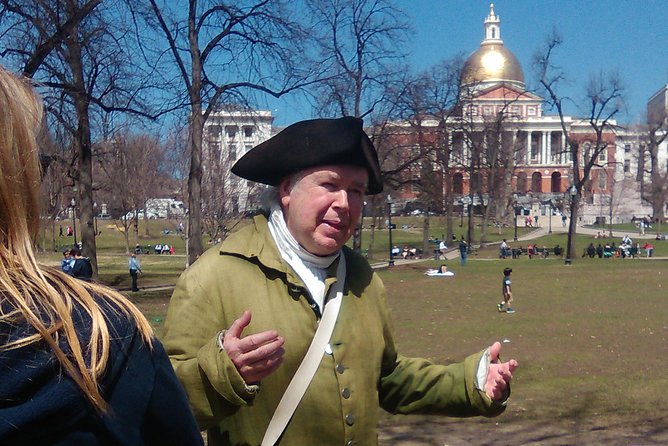
A costumed guide makes Boston history walkable. I love the period-dress storytelling that turns famous names into real scenes, and I love the 90-minute, shorter route that gives you big payoff without eating your whole afternoon. One thing to consider: because this is a time-tight version of the full Freedom Trail, you may still want to come back for a longer walk.
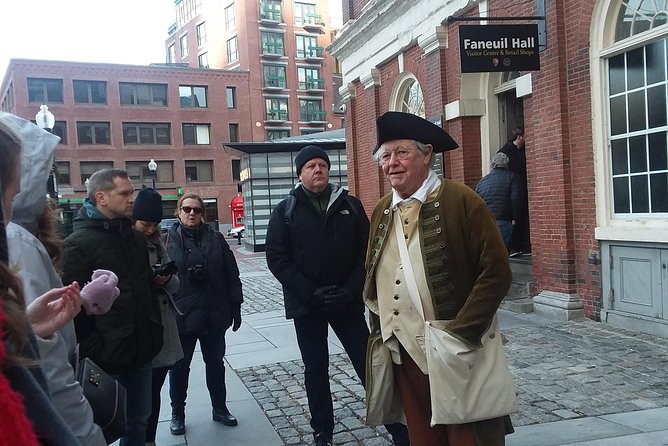
The walk starts at 139 Tremont St and ends at Faneuil Hall Marketplace. It is a gentle stroll with plenty of stops, but you will do a lot of standing and walking, so bring comfortable shoes and dress for weather. Groups are kept small, and the guides use a microphone, which helps when city noise gets loud.
In This Review
- Key things to know before you go
- A $30 way to get oriented on Boston’s Freedom Trail
- Where you start and where you finish matters more than you think
- Park Street Church to Boston Common: the story begins downtown
- Massachusetts State House and Granary Burying Ground: government and dissent
- King’s Chapel and Boston Latin School: ideas older than you expect
- Old South Meeting House and Old State House: meetings that turned into action
- Boston Massacre Site and the ending at Faneuil Hall
- The guide is the real product here
- How long you should plan, and how to make it easier on your body
- Price and value: why $30 can feel surprisingly fair
- Who should book this Freedom Trail walk?
- Should you book it?
- FAQ
- How long is the Freedom Trail walk?
- How much does it cost?
- Is the tour in English?
- Are admission tickets included?
- Is the tour very strenuous?
- What is the cancellation policy?
Key things to know before you go
- Costumed guide narration that follows the path step by step
- A shorter Freedom Trail loop that still hits major landmarks
- Admission tickets included at each of the listed stops
- Easy pace, lots of stops, ideal when you have limited time
- Miked guides plus the option to stand closer for clearer audio
A $30 way to get oriented on Boston’s Freedom Trail
At $30 per person for about 90 minutes, this tour is built for value. You are not paying for a long day or a marathon. You are paying for a guided walk that helps you understand what you are looking at as you move, and that is where the money makes sense.
What I like most is how this format works for real travel days. You get a history reset early enough to still explore on your own later. Or you can do it in the afternoon and then use the morning or evening for neighborhoods, food, and museums you actually want to pick.
The pace is designed to be manageable. It is not a sprint. It is more like a structured walk with time at each stop, so you can actually absorb the story, not just pass by the buildings. City streets are still city streets, though, and you will be outside for long stretches. Weather matters.
More Walking Tours in Boston
- Boston: Freedom Trail History Small Group Walking Tour
★ 5.0 · 6,450 reviews - Harvard University Campus Guided Walking Tour
★ 4.5 · 3,632 reviews - Boston Freedom Trail Walking Tour with Costumed Guide
★ 4.5 · 2,531 reviews
Where you start and where you finish matters more than you think
The meeting point is 139 Tremont St, Boston, MA 02111. That is convenient because you can line up the tour with other downtown plans without needing a big commute.
You finish at Faneuil Hall Marketplace in Boston, MA 02109, which is a smart landing zone. It is central, it is lively, and it puts you right where you can browse shops, grab a snack, or head into nearby neighborhoods. If you like planning with purpose, this ending location makes it easier to turn the tour into a half-day plan instead of a standalone activity.
Also note: mobile tickets are used. That is one less thing to worry about when you are juggling transit, weather, and where you put your phone.
Park Street Church to Boston Common: the story begins downtown

Your first stop is Park Street Church. The commentary here connects early Puritan developments to Protestant change over time. Even if you are not a church person, this is a good anchor point because it sets the tone for the whole walk: Boston’s religious and political ideas evolving side by side.
From there you move to Boston Common. This is where the tour really helps you get bearings. The guide ties early Boston events together so the Common stops feeling like just a big green space and starts feeling like the civic stage it has been for centuries. It is also a relief that Boston Common is easy to picture, because you can look around and visualize how this public area functioned.
If you are a history buff, you will love this early rhythm. If you are more casual, you will still follow along because the story stays grounded in places you can actually see and walk through.
Massachusetts State House and Granary Burying Ground: government and dissent
Next up is the Massachusetts State House, built in 1795. The point of this stop is political and practical. You hear the argument that government is legitimate only with the people’s consent, which gives you a clear theme to carry forward as you pass sites tied to revolution-era tension.
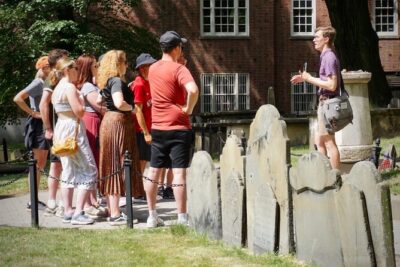
Then you head to Granary Burying Ground, over 350 years old. This stop is not just about dates. It is about people. You will hear that it includes more signers of the U.S. Constitution than anywhere else in America, which makes the cemetery feel like a classroom you can walk through.
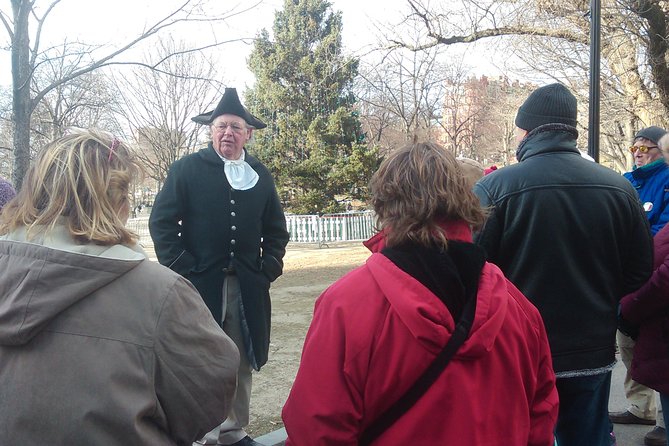
This stop is often the one where the tour’s “costumed guide” approach really pays off. The guide’s voice and timing help you connect names to ideas instead of treating the gravestones like a random collection. It is also one of the longer stops on this route, around 15 minutes, which helps if you want to actually look and read a little before moving on.
One practical note: cemeteries can feel quieter, but downtown street noise can still be around the edges. If your hearing is sensitive, try to stay close to the speaker for the clearest audio.
Other Boston outings to compare
- Boston Food & History: Pizza, North End & Freedom Trail
★ 5.0 · 1,772 reviews - Boston’s Freedom Trail: A Revolutionary Walking Tour
★ 4.9 · 1,748 reviews - Boston: Freedom Trail History Small Group Walking Tour
★ 4.9 · 1,590 reviews - Boston’s Freedom Trail: A Revolutionary Walking Tour
★ 5.0 · 1,343 reviews
King’s Chapel and Boston Latin School: ideas older than you expect
King’s Chapel is next, a historic church originally tied to the Church of England, with an original build around 1688. Even if you only catch part of the detail, you will get a clear sense that Boston’s institutions have shifted over time, and the buildings are the evidence.
Then comes Boston Latin School, where you can see the oldest public school in the United States, founded in 1635. This is a quick stop, about five minutes, but it is an easy one to remember because the idea is so specific. Education here is not just a footnote. It is part of how the colony and later the city shaped its civic future.
If you like history that explains how society gets built, these stops work well. They show that revolution-era change was not only about battles and speeches. It also involved schooling, religion, and community structure.
Old South Meeting House and Old State House: meetings that turned into action
Old South Meeting House is one of the most famous stops on the route. You learn about meetings held there, including a meeting just before the Boston Tea Party in 1773. This is where the tour shifts from background to urgency.
Next you visit the Old State House, built in 1713. You get a clear sense of who controlled it over time: British control first, then American takeover in 1775. That timeline makes the building feel like a moving political scoreboard rather than a static monument.
If you are the type who likes cause and effect, these two stops connect fast. You begin to see how people organized and how decisions turned from talk into confrontation.
Boston Massacre Site and the ending at Faneuil Hall
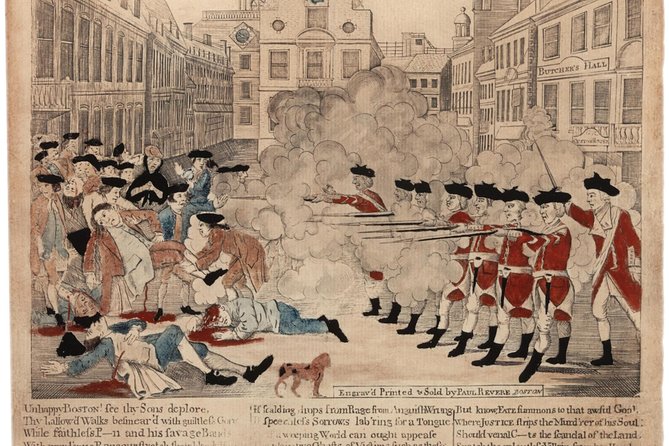
The Boston Massacre Site is next. Five Americans were killed by British soldiers in 1770, and you also hear how Paul Revere’s famous engraving helped spread the image of what happened. This is where you can feel how propaganda, art, and eyewitness storytelling shaped public opinion.
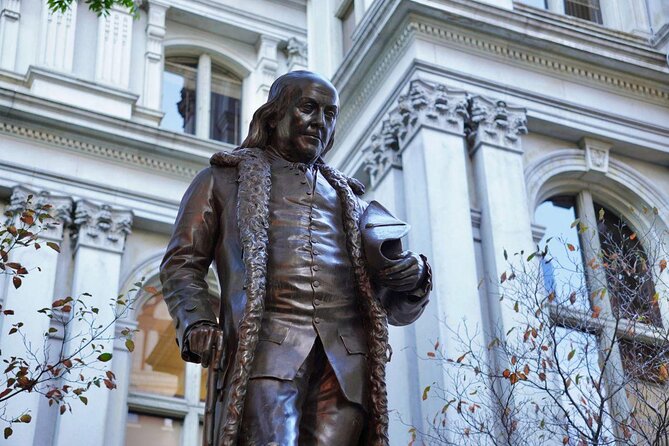
After that, the walk ends at Faneuil Hall Marketplace. You finish strong at a place that is both historic and practical. The guide points out the connection to Samuel Adams, and you get a statue tied to the revolution founder. It is a good way to close the loop because you end in a public space where the same civic energy shows up today in a different form.
Also, this is a great stop to use the tour as a springboard. If your guide shares extra food or neighborhood tips, this is where those recommendations tend to matter, because you are ready to act on them. Some guides have even offered concrete suggestions like lobster roll ideas and pointers toward the North End area.
The guide is the real product here
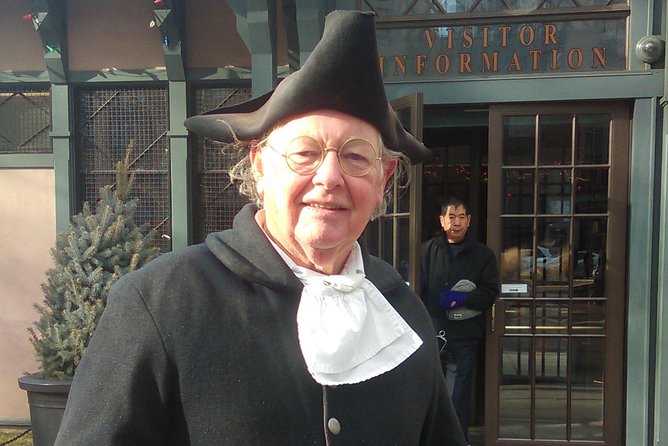
The guide experience is the biggest driver of satisfaction. This tour is built around a costumed narrator who gives commentary as you go, not a lecture you half-listen to while walking past buildings.
The best part is the tone. The tour is serious about facts, but it is not stiff. Humor shows up naturally, and it keeps the long history sections from dragging. That is why the tour works well for couples and friends, and also why it can work for teens. The story is adult-friendly, but it is presented in a way younger visitors can follow.
You will see guide names pop up in past experiences, including James Otis and Thomas. There is also mention of Adri, Steven, Jeff, and others. That tells you something important: the operator invests in performers who can handle crowds, keep timing, and make the material land.
How long you should plan, and how to make it easier on your body
Expect about 90 minutes total, with scheduled time at each stop. You will walk downtown, stand in place for commentary, and move on when the group does.
If you are sensitive to standing time, you can make it easier by bringing a bottle of water and wearing shoes with real grip. Downtown weather can shift quickly, so a light layer is smart even if the forecast looks friendly.
If you have hearing challenges, plan to position yourself near the guide when possible. The guides use microphone amplification, and the operator encourages guests with impaired hearing to stay toward the front.
Price and value: why $30 can feel surprisingly fair
$30 is a reasonable price for a guided, admission-included walking tour that covers key Revolutionary-era and civic landmarks. The value comes from two things:
- You get a lot of context packed into a short time, so you do not have to guess what each building meant.
- Admission tickets are included for the listed stops, which reduces the expense you might otherwise add on your own.
If you are comparing it to the full Freedom Trail experience, this is shorter by design. It covers 11 of the 16 sites on the trail, while the full version takes about three hours. That makes this a smart choice when you want a history foundation now, and maybe a deeper walk later.
Who should book this Freedom Trail walk?
Book this if:
- You are a history buff who wants a fast orientation to Boston downtown.
- You have limited time, but you still want more than a self-guided stroll.
- You like storytelling with period-dress presentation and a steady, guided pace.
Consider a different option if:
- You want to see every Freedom Trail site in one go today.
- You are very sensitive to street noise. This is downtown, and construction and traffic can affect audio clarity sometimes.
Should you book it?
I think this is a strong first Freedom Trail move. The combination of a costumed guide, admission included stops, and a short 90-minute format makes it easy to fit into a Boston schedule. If you want to understand what you are seeing while you are walking, this is the kind of tour that helps everything else in the city click.
If you are the type who returns to a place for a second look, do this now for your base layer of knowledge, then come back later for the longer loop at your own pace.
FAQ
How long is the Freedom Trail walk?
It runs about 1 hour 30 minutes, with a gentle walking pace and scheduled time at each stop.
How much does it cost?
The price is $30.00 per person.
Is the tour in English?
Yes, the tour is offered in English.
Are admission tickets included?
Admission tickets are included for each of the listed stops during the walk.
Is the tour very strenuous?
No. It is described as a gentle 90 minute stroll. Still, you should plan for a lot of walking and standing.
What is the cancellation policy?
You can cancel for a full refund up to 24 hours in advance of the experience start time. If you cancel within 24 hours, the amount paid is not refunded.
More Historical Tours in Boston
- Tour of Historic Fenway Park, America’s Most Beloved Ballpark
★ 4.5 · 3,013 reviews - Boston: City Cruises Historical Sightseeing Cruise
★ 4.6 · 1,771 reviews - City Cruises Boston Historic Sightseeing Harbor Cruise
★ 4.5 · 1,388 reviews - Boston’s North End Food Tour: Italian Flavors & Heritage Walk
★ 5.0 · 1,322 reviews
Newest Boston reviews on the site
- View Boston Observation Deck Admission Tickets★ 4.5 · 314 reviews
- Boston’s Freedom Trail: A Revolutionary Walking Tour★ 5.0 · 1,343 reviews
- Delicious Donuts of Boston: A Sweet History Walking Tour★ 5.0 · 1,038 reviews
- Freedom Trail Walking Tour 250★ 4.5 · 1,118 reviews
- Self Guided Classic Freedom Trail Location Aware (GPS) Walking Audio Tour★ 4.5 · 258 reviews
- Boston’s North End Food Tour: Italian Flavors & Heritage Walk★ 5.0 · 1,322 reviews
- Sunset Sailing Cruise on a Tall Ship in Boston Harbor★ 4.5 · 414 reviews
- Narrated Sunset Cruise of Boston Harbor★ 4.0 · 532 reviews
Freedom Trail Walking Tours, compared.
Freedom Trail History Small Group Walking Tour
Read our review →
Boston Freedom Trail Walking Tour with Costumed Guide
Read our review →
Boston Food & History: Pizza, North End & Freedom Trail
Read our review →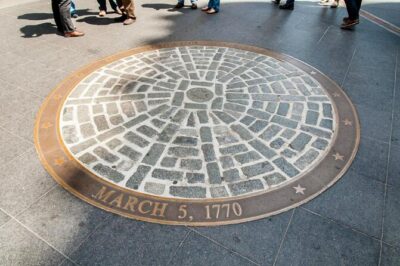
Boston’s Freedom Trail: A Revolutionary Walking Tour
Read our review →Freedom Trail History Small Group Walking Tour
Read our review →Boston’s Freedom Trail: A Revolutionary Walking Tour
Read our review →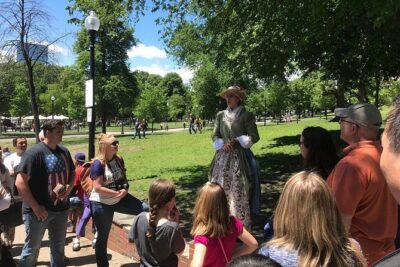

Boston Freedom Trail History Pub Crawl Small-Group Tour
Read our review →Browse the lists this tour appears in