
Reviewed · CHARLESTON TOURS
Charleston History Tour /
A short walk can tell a long story. This 2-hour Charleston History Tour strings together major historic stops in a smart order, so you see how the city’s early roots connect to its later churches, harbor defenses, and cultural life. It also includes time at indoor sites like the Dock Street Theater, not just street photos.
I love the tight pacing and the fact that admission tickets are built in for the stops that charge. I also like the small-group feel, with a max of 10 travelers, which makes it easier for your guide to slow down when a question comes up. On a near-private day, the tour can feel like strolling Charleston with a friend.
One thing to plan for: this experience runs on good weather, and the tour is mostly a walking loop with moderate physical fitness expected. Also, like any group outing, there can be rare last-minute hiccups if a guide is unable to show up, so keep your confirmation handy.
In This Review
- Key things you will notice on this Charleston history loop
- Why this 2-hour walking loop works in Charleston
- Getting started at 80 Broad St, the tour’s easy launch point
- The 1771 stop: where the founding story becomes a place
- Dock Street Theater circa 1810: ornate, but explained in context
- St. Michael’s Church circa 1764: oldest religious building in the city
- Rainbow Row: nine attached buildings and the American Revolution timeline
- Battery and White Point Gardens: defensive seawall plus promenade
- French Huguenot Church (1844): the Gothic Revival detail with a specific claim
- The Gullahs of Charleston: culture as part of the walking route
- Tickets included: the practical value of admission being handled
- Group size, guide quality, and the rare worst-case scenario
- Who should book this Charleston History Tour?
- Should you book this tour?
- FAQ
- How long is the Charleston History Tour?
- Where does the tour start?
- Does the tour return to the starting point?
- Is this tour a walking tour?
- Are admission tickets included?
- What is the group size limit?
- Is food included?
- What fitness level do I need?
- When is the tour running?
- What is the weather policy?
- How flexible is cancellation?
Key things you will notice on this Charleston history loop

- A route designed for quick hits: about 5 minutes at each major stop, enough time to learn and look.
- Admission included at every chargeable site: no surprise line, no extra payment mid-tour.
- Stays human-sized: maximum of 10 travelers, so it does not feel like a school trip.
- Real landmarks with specific dates: 1771, 1764, circa 1810, 1844, and the American Revolution era all show up in the story.
- A culture stop, not just stone buildings: the tour includes a dedicated focus on Gullah culture in Charleston.
- Harbor views with context: Battery and White Point Gardens are explained as defense plus promenade.
Why this 2-hour walking loop works in Charleston
Charleston can overwhelm you fast. Streets are pretty, but without a framework you end up with a pile of photos and no clear timeline. This tour gives you a simple spine: early founding-era Charleston, then the churches and theaters that shaped community life, then the harbor and the cultural thread running through the city.
The schedule is built for momentum. You are out for about 2 hours, with multiple short stops, so you can still enjoy the rest of your day afterward. If you like history, but you do not want to spend half your vacation in lines, this is a strong match.
Another practical win is the small group size. With a maximum of 10 travelers, the guide can actually keep track of the pace. I like that it stays flexible enough for quick questions without turning into a rushed lecture.
Other Charleston outings to compare
- Charleston’s Old South Carriage Historic Horse & Carriage Tour
★ 5.0 · 10,023 reviews - Historic Charleston Guided Sightseeing Walking Tour
★ 5.0 · 6,216 reviews - Charleston Horse-Drawn Carriage Tour: Explore Historic Charleston
★ 5.0 · 3,561 reviews
Getting started at 80 Broad St, the tour’s easy launch point
The tour begins at 80 Broad St, Charleston, SC 29401, and it returns back there at the end. That matters more than you might think. When a walking tour starts and ends at the same spot, you do not have to re-plan transport or hunt for where you left your car.
Also, this starting location helps you get oriented fast. Charleston’s historic core can feel like a maze if you are new. Having a guided loop in place means you can map what you see as the story builds, from founding-era homes and public life to religious and cultural landmarks.
You will also use a mobile ticket, which keeps things simple at the start. No paper scavenger hunt. Just be sure your phone battery is healthy before you meet.
The 1771 stop: where the founding story becomes a place
One stop is built in 1771, described as a home tied to the ratification of the United States Constitution. That is a big claim, and the value of visiting a place like this is that it makes the abstract feel concrete. A date on a page is one thing. A building that existed during that moment is something else entirely.
In a short stop like this, the goal is not to memorize every detail. It is to understand why a building from 1771 matters in Charleston specifically, and how the city’s identity connects to national events. When your guide ties the story to the streets around you, you will likely find yourself noticing architectural cues and location choices more clearly later.
If you are the type who likes to ask, this is also a good moment. It tends to spark questions like how a city’s political importance shows up in everyday life, not just in famous documents.
Dock Street Theater circa 1810: ornate, but explained in context

Next up is the Dock Street Theater, an ornate playhouse with elegant woodwork and a courtyard, dating to around 1810. This is one of the stops that adds variety to the tour. You are not only walking past history. You are stepping into a space meant for public gatherings and performance.
Even with only about 5 minutes here, it works because the tour is not asking you to treat this like a museum marathon. You get the key look and the story behind why such a theater belonged in Charleston when it did.
What I like about this stop is the way it breaks up the heavier topics. A theater can feel like a detour if you only care about politics and churches. But when it is explained as part of how a community spent time, what people valued, and how design communicated status, it stops feeling like a side quest.
Same corner of the map, another day out:
- Haunted Evening Horse and Carriage Tour of Charleston
★ 4.5 · 3,678 reviews - Fort Sumter Admission and Self-Guided Tour with Roundtrip Ferry
★ 4.5 · 3,343 reviews - Ghosts of Charleston Night-Time Walking Tour with Unitarian Church Graveyard
★ 4.5 · 2,835 reviews - Charleston Harbor History Day-Time or Sunset Boat Cruise
★ 4.5 · 2,788 reviews
St. Michael’s Church circa 1764: oldest religious building in the city

Then you hit St. Michael’s Church, dating to around 1764 and described as the oldest religious building in Charleston. This is the kind of stop that rewards attention, even if the time is short.
Religious buildings often act like anchors in a historic city. They hold a long presence and become reference points you can use to read the neighborhood around them. When a guide ties St. Michael’s to that idea, you get more than a quick glance at a historic structure. You start noticing how the city’s landmarks create a sense of continuity.
One practical tip for this stop: keep your eyes up and slow down for the “whole building” view first. It is easy to get distracted by details. If you first take in the shape and placement, the details will make more sense as you move around.
Rainbow Row: nine attached buildings and the American Revolution timeline
A highlight for many people is Rainbow Row, made up of 9 buildings attached to one another. All but one predate the American Revolution, and that date detail is the point. Buildings that survive from specific periods tell you something about what changed and what held steady.
Because the tour gives you only about 5 minutes at this stop, you want to use that time well. I suggest you do a quick sweep: take the full row in first, then pick two or three buildings to study more closely. If your guide points out what to compare between the ones that predate the Revolution and the odd one out, you will likely feel the timeline snap into place.
Rainbow Row also works as a mental reset. After churches and historic civic spaces, this is a visual landmark that helps your brain “store” what you learned. You walk away with a picture and a timeline, not just a blur of pretty facades.
Battery and White Point Gardens: defensive seawall plus promenade
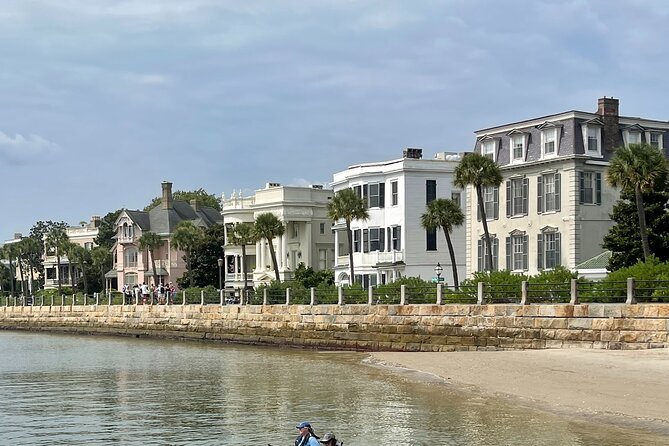
The tour moves from buildings to the coastline with the Battery and White Point Gardens. Here, the Battery is described as a defensive seawall and promenade along Charleston Harbor. That combination, defense and walking space, is part of what makes the stop worth it.
It is easy to look at the waterfront and only see scenery. With a guide, you get the other layer: why a city would build in this exact way along the harbor and how that defensive design shaped what people did nearby. Even in a short stop, a good explanation can change how you read the entire harbor edge.
Also, if you are the kind of traveler who loves views, this is a strong moment in the route. You get a “look” payoff, and the guide keeps it connected to the city’s story rather than letting it become a generic photo break.
French Huguenot Church (1844): the Gothic Revival detail with a specific claim
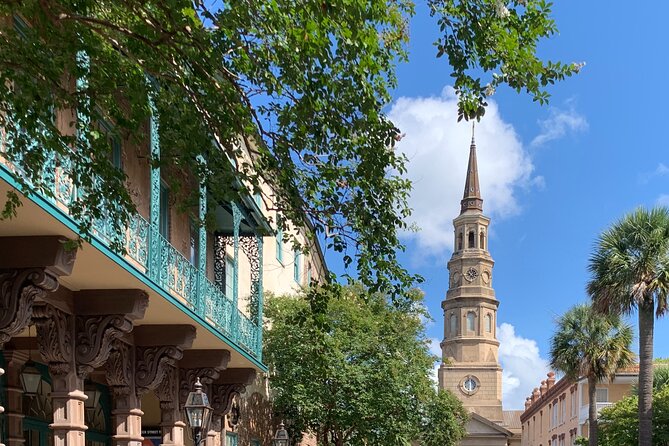
Next is the French Huguenot Church, built in 1844 and described as the oldest Gothic Revival church in South Carolina, plus the only independent Huguenot Church in the country. That is a lot of specificity, and it is what makes this stop feel meaningful rather than just scenic.
In a short visit, you can still catch what makes Gothic Revival different, without needing a full art history class. The tour’s value is that it frames the church inside a larger narrative: how different communities shaped Charleston, how religion organized public life, and how architecture carried identity.
If you care about faith history and cultural migration, you will probably enjoy this stop because it has clear markers. You know exactly what to look for, and you know why the location matters.
The Gullahs of Charleston: culture as part of the walking route
A big part of why this tour feels well-rounded is that it includes learning about the Gullahs of Charleston. This is not presented as a random add-on. It is positioned as a cultural thread, one that belongs alongside founding-era landmarks and the city’s major religious buildings.
What I like here is that it broadens your understanding of Charleston beyond white-column facades. Even if you only have a short window, a dedicated segment on Gullah culture helps you connect the city’s history to the lived culture that shaped daily life.
If you take one thing from this segment, make it this: Charleston’s history is not only political dates and architecture. Culture and community are part of the same story, and a good tour treats them that way.
Tickets included: the practical value of admission being handled
This is one of those tours where the details matter for your day. The tour info states that all sites seen will not require additional payments, and it specifically notes admission tickets included for the main stops like Dock Street Theater, St. Michael’s Church, Rainbow Row, Battery and White Point Gardens, and the French Huguenot Church.
That is good value in a very real way. You avoid the awkward mid-tour moment of figuring out ticket lines, payment methods, and whether something is sold out. It keeps your schedule cleaner, and your brain can focus on what the guide is explaining instead of logistics.
One small thing to plan around: food and drinks are not included. So if you are doing this in the middle of your day, I recommend you eat before you meet at 80 Broad St or plan a quick stop afterward. Hydrate too. Even short stops add up when you are walking and standing in historic areas.
Group size, guide quality, and the rare worst-case scenario
This tour caps out at 10 travelers, which is ideal for getting personal attention. In one standout experience described, the guide named Joyce delivered a lively, organized walk covering city development, military related facts, architectural points, and cultural highlights. The tone was described as enthusiastic and pleasant, and it felt like a friendly conversation while you walked.
I also like that the tour can get very intimate when demand is low. On a day when only two people were booked, it naturally felt more private. That is the kind of small-group upside you cannot rely on for every date, but it is a real possibility with this format.
Now the caution side: one review described a situation where the guide was absent and the visit did not happen, with no response by phone or messaging and no plan B mentioned. The provider later apologized and said the guide had been taken to the hospital, so it sounds like a genuine emergency rather than a business choice. Still, it is smart to be practical. Bring your confirmation on your phone and keep your expectations flexible, especially if you are traveling with tight timing.
Who should book this Charleston History Tour?
You should strongly consider booking if you want:
- A 2-hour guided overview that covers founding-era connections, major churches, and a harbor defense story
- A route with admission included, so you can travel light and avoid extra payments
- A manageable walking pace with a moderate fitness level and short, focused stops
You might not love it if you want long time inside each site, deep museum-style reading, or a tour that functions like a slow art stroll. The format is designed for “learn and move,” not “sit and study for an hour.”
Should you book this tour?
Yes, I think you should book if you like a guided route that gives you a clear timeline without draining your whole day. The combination of included admissions, a tight historic focus, and the small-group cap of 10 travelers makes it good value in time and planning effort.
Book it especially if you are visiting Charleston for the first time and want to get your bearings quickly. You will leave with a set of anchor places, like Rainbow Row, St. Michael’s Church, and the French Huguenot Church, and you will understand how the stories connect, not just what the buildings look like.
Just do yourself a favor and plan around weather. If you are arriving in Charleston on a day that looks iffy, consider that this experience requires good weather to run.
FAQ
How long is the Charleston History Tour?
It runs for about 2 hours.
Where does the tour start?
The meeting point is 80 Broad St, Charleston, SC 29401, USA.
Does the tour return to the starting point?
Yes, it ends back at the meeting point.
Is this tour a walking tour?
Yes, it is a walking route with multiple stops around Charleston.
Are admission tickets included?
Yes. All sites seen will not require additional payments, and admission tickets are included for the listed stops.
What is the group size limit?
The tour has a maximum of 10 travelers.
Is food included?
No. Food and drinks are not included.
What fitness level do I need?
You should have a moderate physical fitness level.
When is the tour running?
For 03/15/2025 to 12/31/2025 and 03/15/2026 to 12/31/2026, it runs Monday through Saturday from 9:00 AM to 5:00 PM.
What is the weather policy?
This experience requires good weather. If it is canceled due to poor weather, you will be offered a different date or a full refund.
How flexible is cancellation?
You can cancel for free up to 24 hours in advance for a full refund.
Newest Charleston reviews on the site
- Middleton Place Admission with Self Guided Tour and Lunch★ 4.5 · 326 reviews
- Charleston Ghosts of Liberty Guided Walking Tour★ 4.5 · 473 reviews
- Charleston’s Best Highlights: History, Culture & Architecture★ 5.0 · 422 reviews
- Charleston Chicora 2 Hours Walking Tour★ 5.0 · 264 reviews
- Small-Group Tour: Charleston Old Walled City Historical Walking Tour★ 4.5 · 283 reviews
- 2-Hour Guided Kayak Eco Tour in Charleston★ 5.0 · 954 reviews
- Sip History in The Sun Cabana Covered Cocktail Class★ 5.0 · 332 reviews
- Private Luxury Yacht Charters, BYOB & Dolphins★ 5.0 · 395 reviews
Charleston Tours, compared.
Charleston’s Old South Carriage Historic Horse & Carriage Tour
Read our review →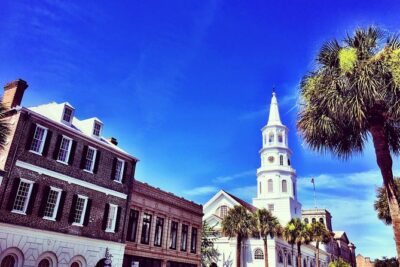
Historic Charleston Guided Sightseeing Walking Tour
Read our review →
Haunted Evening Horse and Carriage Tour of Charleston
Read our review →
Charleston Horse-Drawn Carriage Tour: Explore Historic Charleston
Read our review →
Fort Sumter Admission and Self-Guided Tour with Roundtrip Ferry
Read our review →
Ghosts of Charleston Night-Time Walking Tour with Unitarian Church Graveyard
Read our review →
Charleston Harbor History Day-Time or Sunset Boat Cruise
Read our review →
Hidden Alleyways and Historic Sites Small-Group Walking Tour
Read our review →Browse the lists this tour appears in