
Reviewed · ARCHITECTURE TOURS & CRUISES
Charleston’s Best Highlights: History, Culture & Architecture
Charleston’s streets teach history fast. This walking tour strings together the city’s major landmarks and the stories that shaped South Carolina and the US. You get a licensed guide who turns stone, pews, and old brick into a clear timeline you can actually remember.
I especially love the way the tour connects big national moments to specific buildings. Stops like the Old Exchange and Provost Dungeon link directly to events such as the Declaration of Independence being read in 1776 and the US Constitution being ratified in South Carolina in 1788. I also love the mix of architecture and atmosphere, including Tiffany-stained glass at St. Michael’s Church and the preserved Georgian row houses of Rainbow Row.
One thing to plan for, though: some entrances depend on availability, and a couple of the most meaningful stops do not include entry. You’ll also be outdoors most of the time, so comfortable shoes and decent weather really matter.
In This Review
- Key highlights you will get from this tour
- A 2-hour walk where Charleston’s key stories line up neatly
- Starting at the Old Exchange and Provost Dungeon, c. 1771 to 1791
- Rainbow Row, Georgian row houses and a restoration story with color
- Facing the Old Slave Mart Museum without going inside
- French Huguenot Church, Gothic Revival and a rare living tradition
- Dock Street Theater and Charleston Stage, where the past became a performance venue
- Charleston City Hall, the Four Corners of Law and a peek inside
- St. Michael’s Church, c. 1761 and Tiffany stained glass that actually matters
- Nathaniel Russell House garden, Federal-style comfort with merchant power
- Edmondston-Alston House area and High Battery views toward Fort Sumter
- Group size, pace, and how to make the walk feel personal
- Value and what is included, not included, at each stop
- When this tour is the best match for you
- Should you book this Charleston highlights tour?
- FAQ
- How long is the tour?
- What language is the tour offered in?
- Where does the tour start and end?
- Is admission included for every stop?
- Are there any free stops?
- Does the tour enter all buildings?
- How big is the group?
- Is the tour wheelchair or mobility friendly?
- What is the weather policy?
- Are service animals allowed?
Key highlights you will get from this tour
- A licensed guide who ties buildings to real events, not just dates
- Old Exchange and Provost Dungeon, with layers from independence to imprisonment
- Rainbow Row photo stop, plus the reason those houses got restored in a Caribbean color scheme
- Old Slave Mart Museum area focus, including the inter-state slave trade context (without going inside)
- St. Michael’s Church stops for churchyard history, including Constitution signer burials
- High Battery views toward Fort Sumter, for a Civil War beginning-of-the-story perspective
A 2-hour walk where Charleston’s key stories line up neatly
Charleston can feel like a museum where you are not sure where to start. This tour fixes that problem by giving you a strong “spine” through downtown in about two hours, starting at 122 E Bay St and ending back where you began.
The group stays small, up to 20 people. That matters because it makes it easier to ask questions and to keep a comfortable pace on crowded sidewalks. It is also a great length for a first visit, or for a return trip when you want the history to click instead of just sightseeing.
Expect a lot of outside viewing, plus a few moments where you can get closer, like a garden entry and the chance to see inside at City Hall on weekdays if there is room.
Other Charleston outings to compare
- Charleston: History and Architecture Guided Walking Tour
★ 4.8 · 349 reviews - Charleston History, Homes, and Architecture Guided Walking Tour
★ 5.0 · 267 reviews - Chicago Architecture River Cruise
★ 5.0 · 15,756 reviews
Starting at the Old Exchange and Provost Dungeon, c. 1771 to 1791
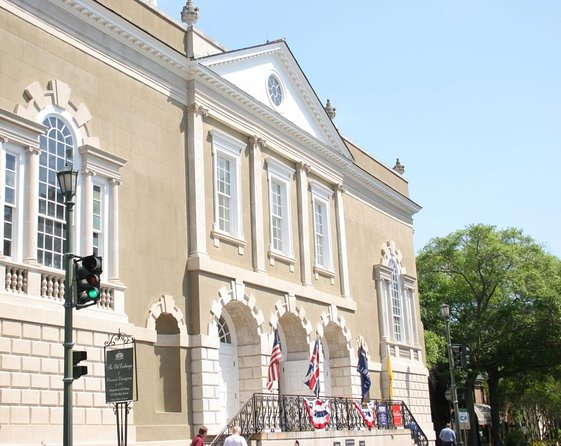
Your walk begins in one of South Carolina’s most event-heavy buildings, built around 1771. This is where the Declaration of Independence was read in 1776, and where the British held prisoners during the American Revolution for roughly two years.
The story does not stay in the revolution era. You also get the connection to the US Constitution ratification in 1788, when South Carolina formally said yes. And then there is George Washington’s week-long visit in May 1791, when he was entertained here.
What I like about starting here is that it gives you a “North Star” for the rest of the walk. After you hear what happened inside these walls, the later stops about religion, civic life, and Civil War geography feel more connected, not random.
Tip: since admission is not included for this stop, decide early how much you want to do beyond the tour narrative. If you want to go inside on your own time, plan that separately.
Rainbow Row, Georgian row houses and a restoration story with color
Then you shift from national politics to visual postcard Charleston at Rainbow Row. You will see the longest row of attached Georgian row houses in the country, and you will learn that these were mariners’ stores in the 18th and 19th centuries.
A key part of what makes this stop fun is the restoration story. During Charleston’s preservation efforts in the 1930s, the houses were brought back in a bright Caribbean color scheme. It is one of those details that makes you look twice at the street instead of glancing and moving on.
Practical note: this is a short stop, so aim to have your camera ready. Also, if you are thinking about longer photo time, do it quickly here, because the rest of the route is packed with more “stand and listen” moments.
Facing the Old Slave Mart Museum without going inside

Next comes one of the hardest stops, and it is handled with care. The building is known as Ryan’s Slave Mart in the 1850s and was an auction site in the interstate slave trade.
You will talk about Charleston’s role in that system, and the tour is clear that the museum building itself is not entered. That might sound like a letdown if you expect doors to open at every stop, but it can also be a good way to manage expectations and keep the tour flow respectful.
Here is the value for you: you get context on what happened in the space, and then you can choose whether you want to go deeper on your own. The museum is operated by the City of Charleston and tours are available on site, so you can extend your learning if you want more.
If you are visiting with kids or anyone who gets uncomfortable with heavy topics, this is still a useful stop because the conversation is guided and framed rather than left to guesswork.
Same corner of the map, another day out:
- Charleston’s Old South Carriage Historic Horse & Carriage Tour
★ 5.0 · 10,023 reviews - Historic Charleston Guided Sightseeing Walking Tour
★ 5.0 · 6,216 reviews - Haunted Evening Horse and Carriage Tour of Charleston
★ 4.5 · 3,678 reviews - Charleston Horse-Drawn Carriage Tour: Explore Historic Charleston
★ 5.0 · 3,561 reviews
French Huguenot Church, Gothic Revival and a rare living tradition
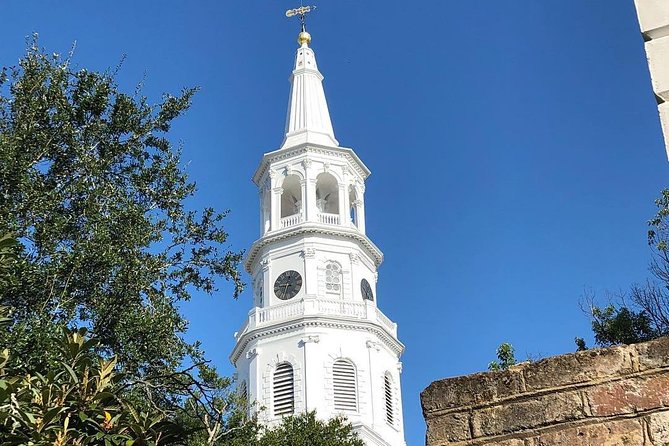
A quick hop brings you to the French Huguenot Church, a Gothic Revival building from 1845. This matters because it is not just architecture, it is about a living community, with one of the only practicing Huguenot congregations in the country.
In practical terms, you will likely spend only a few minutes here, but that short stop works because it adds a different kind of history to the walk. Instead of focusing only on politics and commerce, you are also learning about faith and immigration patterns that shaped Charleston.
If you love religious architecture, pay attention to the building’s form. It is easy to walk past something this old and think it is just pretty. The guide helps you see what it represents.
Dock Street Theater and Charleston Stage, where the past became a performance venue
At Dock Street Theater, your entrance depends on availability, so keep expectations flexible. The site has layers, too: it was built on the location of the first theater in the British colonies, and the current Dock Street Theatre, dating around 1937, was restored from the old Planter’s Hotel (around 1809).
This stop adds a cultural angle to your day. Charleston is not only historic houses and churches, it also has an ongoing arts scene. The Charleston Stage company operates as the largest professional theater company in South Carolina, with roughly 120 performances every year.
If the building doors are open, you can connect the theater’s story to your walk. If not, you still get the context that this is a place where entertainment has been part of Charleston’s street life for a long time.
Charleston City Hall, the Four Corners of Law and a peek inside
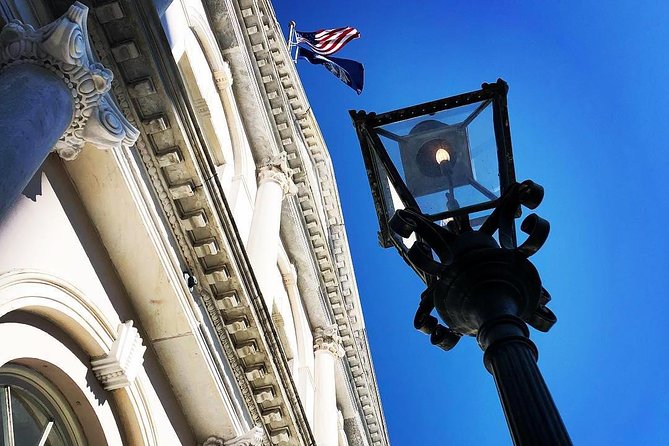
Then you hit a civic landmark with a fun fact baked in. The building sits in one of the Four Corners of Law, a label connected to Robert Ripley’s Believe it or Not.
City Hall was built in 1801 as a bank, and it has functioned as City Hall since 1818. It is also one of the oldest continuously run city halls in the country, which makes your stop feel more real than “historic” in the decorative sense.
During weekdays, visitors can enter the council chamber and see the collection complimentary. That detail is valuable because it is one of the few times on this route when you might get a true interior break.
Tip: if you are visiting on a weekday and you want that inside view, arrive with enough time to catch it during the open window. Your guide will set expectations, but planning helps.
St. Michael’s Church, c. 1761 and Tiffany stained glass that actually matters
St. Michael’s Church is the kind of stop that makes you slow down without forcing you to. It is considered the oldest house of worship in the city, around 1761, and the tour also covers Charleston’s religious history past and present.
You will see original woodwork and beautiful Tiffany stained glass windows. And in the churchyard, you learn about burials tied to the US Constitution, including John Rutledge and Charles Cotesworth Pinckney.
The best part of this stop for you is the blend. Architecture matters here, but so does the human story. When you leave, you understand why this church keeps coming up in discussions about Charleston’s role in the founding era.
Entrance depends on availability, so if you cannot go inside, you will still get the meaning and the key details.
Nathaniel Russell House garden, Federal-style comfort with merchant power
The Nathaniel Russell House is a Federal-style townhouse built in 1808 and tied to Nathaniel Russell, a wealthy merchant involved in shipping. You will enter the garden of this home, which gives you a quieter pocket of the tour compared to the busier street corners.
The garden entry is a nice balance. It prevents the walk from becoming only “look at buildings” while standing in traffic noise. It also helps you understand how wealthy merchants lived, not just where political leaders made speeches.
Because the stop is focused on the garden, you should expect a more relaxed pace here. It is a good moment to ask questions if you have them, since your group is often not rushed through a doorway the way you might be at a museum entrance.
Edmondston-Alston House area and High Battery views toward Fort Sumter
Near the waterfront, you walk up to the High Battery wall for views toward the mansions and the harbor. This is where the tour shifts to the beginning of the Civil War story.
You can see Fort Sumter from this vantage point, which makes the history feel less like a textbook and more like geography you are standing in. The Edmondston-Alston House is connected to this moment too, since it was a site where Gen. Beauregard watched the bombardment of Fort Sumter alongside other onlookers.
What I like about ending this way is that it gives you a mental map for the rest of your visit. After this, you can look at the waterfront and think about timelines and cause-and-effect, not just ships and views.
If you tend to get tired in heat or after a long day, plan a short break after this part. The rest of your tour time is likely spent wrapping up and finishing back at the meeting point.
Group size, pace, and how to make the walk feel personal
This tour runs with a maximum of 20 people, and the format is built for interaction. You should feel free to ask questions as you go, especially if you have a specific interest like theater, religion, or the founding era.
Guides often tailor the flow to the group, and names like Brian and Finn show up in people’s experiences as strong teachers. Even if you do not get those exact guides, you can still expect a style that leans on clear storytelling and willingness to answer questions.
One more practical tip: plan for the tour to run a little longer than the approximate two hours. When people are having a good conversation, the pace slows in a good way. Build some breathing room into your schedule after the walk.
Value and what is included, not included, at each stop
This is a smart value format because it mixes free viewing with a few paid-experience options. Some stops are free to view from the outside, like Rainbow Row, French Huguenot Church, Dock Street Theater depending on availability, City Hall, and St. Michael’s Church.
Others do not include admission tickets. Old Exchange and Provost Dungeon is one example, and Nathaniel Russell House is another where you enter the garden rather than the full interior experience. The Old Slave Mart Museum is also a special case, since you learn about it without entering the building.
So for your planning, you can think of it like this:
- If you want maximum value, let the guide do the storytelling and enjoy the free stops fully.
- If you want maximum depth, budget a little extra for the sites where you might want to go inside on your own.
Also keep in mind this is outdoors most of the time. Comfortable shoes beat fancy sandals here.
When this tour is the best match for you
This tour is ideal if you want a high-impact introduction to Charleston’s history and architecture without committing to a full half-day. It is also a strong choice for returning visitors, since the route focuses on connections you might miss when you visit on your own.
You will probably enjoy it most if:
- You like guided context, not just facts on signs
- You enjoy walking and asking questions
- You want a route that covers politics, religion, culture, and Civil War geography in one go
If you dislike walking or standing around while someone explains details, this may feel like too much time in “listen mode.” If that is you, look for a shorter, more visual-focused option instead. For most people, though, this balance hits well.
Should you book this Charleston highlights tour?
I think you should book it if you want the quickest way to turn Charleston into something you understand. Starting with the Old Exchange and Provost Dungeon, then moving through landmarks tied to law, faith, and war gives you a framework you can use all week.
Also, the small group size and interactive guide style make it more than a simple stroll. You will leave with a stronger sense of the city’s timeline and why these buildings matter.
Just go in with realistic expectations: not every stop is a paid entry, a couple doors can depend on availability, and one major theme is intentionally handled by learning about it without going inside a museum room. For many visitors, that is the right way to do a heavy topic.
FAQ
How long is the tour?
It is approximately 2 hours.
What language is the tour offered in?
The tour is offered in English.
Where does the tour start and end?
The tour starts at 122 E Bay St, Charleston, SC 29401, USA, and ends back at the meeting point.
Is admission included for every stop?
No. Admission tickets are not included for some stops, and for Old Slave Mart Museum you do not enter the building.
Are there any free stops?
Yes. Several stops are listed as free, including Rainbow Row, French Huguenot Church, Old Slave Mart Museum learning context (without entry), Dock Street Theater (entrance depends on availability), Charleston City Hall, and St. Michael’s Church (entrance depends on availability).
Does the tour enter all buildings?
No. For example, the Old Slave Mart Museum building is not entered. Other stops may offer entry depending on availability.
How big is the group?
The tour has a maximum of 20 travelers.
Is the tour wheelchair or mobility friendly?
The tour states that most travelers can participate, but no other accessibility details are provided here.
What is the weather policy?
This experience requires good weather. If it is canceled due to poor weather, you will be offered a different date or a full refund.
Are service animals allowed?
Yes, service animals are allowed.
Newest Charleston reviews on the site
- Middleton Place Admission with Self Guided Tour and Lunch★ 4.5 · 326 reviews
- Charleston Ghosts of Liberty Guided Walking Tour★ 4.5 · 473 reviews
- Charleston Chicora 2 Hours Walking Tour★ 5.0 · 264 reviews
- Small-Group Tour: Charleston Old Walled City Historical Walking Tour★ 4.5 · 283 reviews
- 2-Hour Guided Kayak Eco Tour in Charleston★ 5.0 · 954 reviews
- Sip History in The Sun Cabana Covered Cocktail Class★ 5.0 · 332 reviews
- Private Luxury Yacht Charters, BYOB & Dolphins★ 5.0 · 395 reviews
- Afternoon Schooner Sightseeing Dolphin Cruise on Charleston Harbor★ 4.5 · 620 reviews
Architecture Tours & Cruises, compared.

Chicago River: 1.5-Hour Guided Architecture Cruise
Read our review →
Chicago Architecture Center River Cruise aboard First Lady
Read our review →
Architecture River Cruise Skip-the-Ticket Line
Read our review →
Chicago River 45-Minute Architecture Tour from Magnificent Mile
Read our review →
45-Minute Family-Friendly Architecture River Cruise
Read our review →Browse the lists this tour appears in