
Reviewed · PHILADELPHIA TOURS
Revolution and the Founders: History Tour of Philadelphia
Old City moves fast, if you let it. I like the history-degree guides and the way they stitch key founding-era stops into a tight two-hour walking route. It is built for people who want an instant feel for 1776, not a slow museum crawl. The main tradeoff is simple: it is outdoors, so cold, wind, and standing time can test your patience.
This tour is also good value at $29 for a guided hit list of revolutionary landmarks, plus a free day-planning boost for the rest of your trip. You get a mobile ticket, runs in the morning and afternoon, and the group stays small (up to 24), which makes it easier to ask questions and keep pace.
One more practical thing to know upfront: some of the biggest interiors are limited. Independence Hall needs free timed entry passes, and the Liberty Bell pavilion interior is not part of the main visit, though you can get clear guidance for where and how to go if you want to add that extra hour.
In This Review
- Quick reasons this Philadelphia tour is worth your time
- Why this Revolution and Founders walk works so well for first-timers
- Meeting at Grim Philly Twilight Tours and what the 2-hour pace feels like
- Liberty Bell pavilion: the cracked bell story and the queue reality
- Independence Hall with free timed passes, plus a quick look inside
- The President’s House and Congress Hall: Washington, Adams, and the political stage
- Franklin Court and the First Pentagon location: strategy plus inventions
- The Benjamin Franklin Post Office Museum: daily life in a revolutionary frame
- Carpenters’ Hall and the French support thread
- First Bank and Second Bank: Hamilton, Jackson, and the money storyline
- America’s early “thinkers” and learning institutions: Philosophical Society and Library Company
- Dolley Madison’s house: the middle-class side of founding Philadelphia
- Price and value: is $29 fair for what you get?
- Who should book this tour, and who might feel the friction
- Should you book Revolution and the Founders in Philadelphia?
- FAQ
- How long is the Revolution and the Founders history tour?
- What does it cost per person?
- Is this a small group tour?
- Do I need timed entry passes for Independence Hall?
- Is the Liberty Bell pavilion interior included?
- Does the tour run rain or shine?
- Can I choose a morning or afternoon tour?
- What is the cancellation policy for a full refund?
Quick reasons this Philadelphia tour is worth your time
- History-degree guidance with storytelling that turns dates into people
- Two hours, lots of landmarks, ideal when you want the essentials without burning your whole day
- Liberty Bell and Independence Hall focus with smart navigation around crowds
- Franklin Court and the Benjamin Franklin Post Office add texture beyond the monuments
- A small group cap (24) helps you stay engaged on a walking route
Why this Revolution and Founders walk works so well for first-timers
Philadelphia has a lot of history packed into a compact area, but it is easy to feel overwhelmed. This tour gives you a structured way to make sense of the city’s founding story, starting with the symbols of independence and moving through the people, institutions, and everyday details that made it all possible.
I like that it is not trying to do everything. In two hours, you get orientation plus enough backstory to help you read the city after you’re done walking.
If you are a history buff, great. If you’re not, you will still come away with clear anchors: why the Liberty Bell matters, what Independence Hall hosted, and how Franklin and others shaped both the revolution and the new nation.
Other Philadelphia outings to compare
- Philadelphia Old City Historic Walking Tour with 10+ Top Sites
★ 5.0 · 2,020 reviews - Philadelphia: Revolution and The Founders History Tour
★ 4.6 · 450 reviews - Philadelphia: History, Highlights & Revolution Walking Tour
★ 4.9 · 317 reviews
Meeting at Grim Philly Twilight Tours and what the 2-hour pace feels like
You start at Grim Philly Twilight Tours, 523 Market St and end near 143 S 3rd St, just behind City Tavern and the Merchants Exchange area. The meeting point is easy to find in Old City, and it is near public transportation, which is handy if you are juggling plans.
The tour runs every morning and every afternoon and goes rain or shine. That matters because the route is outdoors, and you do not want a “maybe we will cancel” day derailing your schedule.
The pace is intentionally brisk. Guides keep you moving so you see the key places, rather than spending half the tour stuck waiting to enter buildings. On very busy days or when it is cold, that pacing can feel tiring, but it also prevents the walk from turning into a stop-and-go ordeal.
Liberty Bell pavilion: the cracked bell story and the queue reality
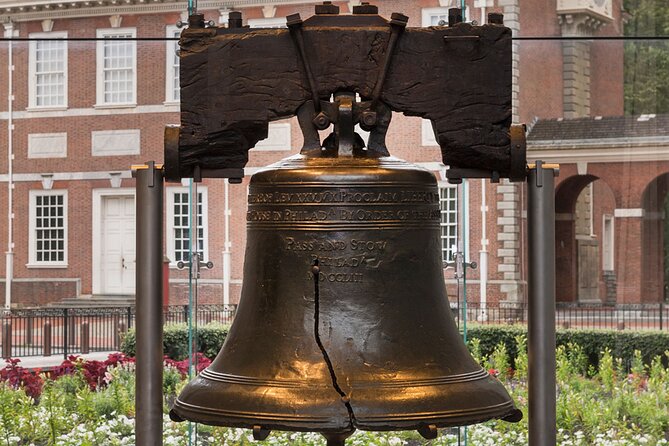
Your first major stop is the Liberty Bell in the National Historic Park area. This is the fastest way to connect with one of the most recognizable icons in American history, and the exterior views make it easy to understand what you are looking at even if you are short on time.
The tour focuses on how the bell was commissioned in 1752, how it cracked on its initial test ring, and how it was recast by local workmen John Pass and John Stow two years later. You also get the famous inscription context, including the wording from a King James Bible quote about liberty and the jubilee theme.
Be realistic about the modern experience. In peak season, the Liberty Bell can draw long lines, sometimes close to an hour just to traverse the destination area. The tour keeps you oriented and gives you clear directions if you want to add interior time later, but you should not expect a long sit-down visit here as part of the core plan.
Independence Hall with free timed passes, plus a quick look inside
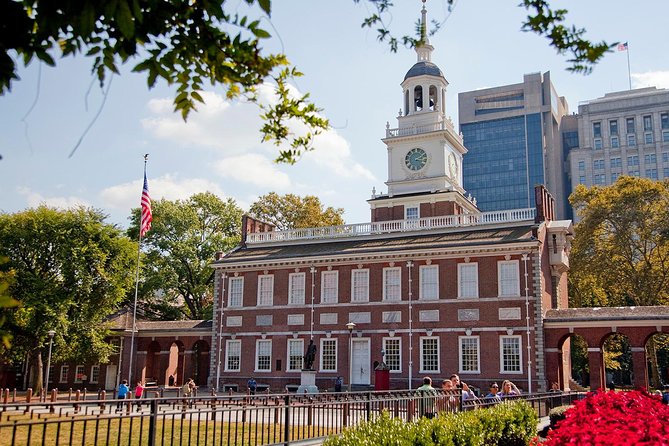
Next up is Independence Hall, the site where both the Declaration of Independence and the Constitution were debated and adopted. This is the big payoff stop for anyone who wants to walk straight into the narrative of American democracy.
Here is the practical part you need to plan for: the Independence Hall complex requires free timed entry passes. The tour provides guidance for that, but you should build in extra time for the complex itself because the interior exploration window can be longer than the walking tour time.
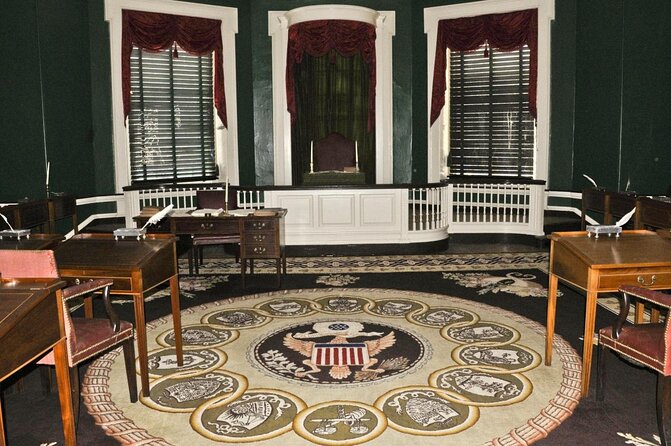
During the guided portion, you get a fast-moving highlight visit, including a quick pit-stop inside the East Wing, described as the oldest and most historic part of the structure, served while Philadelphia was the nation’s capital. That means you get a taste of the most important interior cues without turning the tour into a waiting game.
Crowds and closures can affect what’s possible on any given day. If you are the type who loves lingering, plan your own follow-up time after the tour. If you want the core story delivered efficiently, this stop hits the right balance.
Same corner of the map, another day out:
- Dark Philly Adult Night Tour
★ 5.0 · 4,241 reviews - Philadelphia Hop-On Hop-Off City Tour
★ 4.0 · 2,347 reviews - Philadelphia: Double-Decker Hop-on Hop-off Sightseeing Tour
★ 4.4 · 868 reviews - Double Decker Hop-On Hop-Off City Sightseeing Philadelphia (1, 2, or 3-Day)
★ 4.0 · 562 reviews
The President’s House and Congress Hall: Washington, Adams, and the political stage

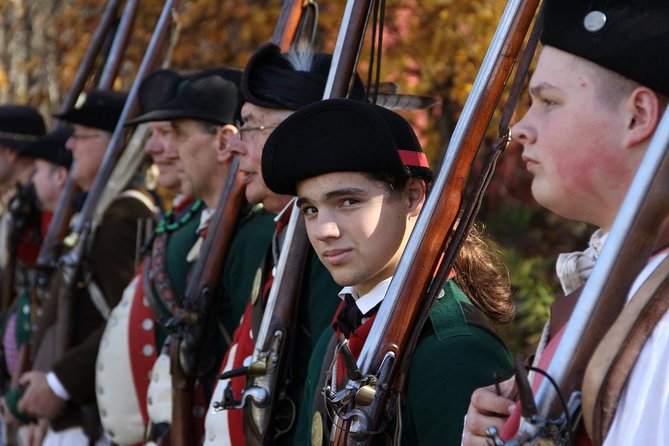
After Independence Hall, the tour moves into the surrounding world where early leaders lived and worked. You visit the area tied to America’s first White House, known as the President’s House, where George Washington and John Adams served while Philadelphia was the U.S. capital from 1790 to 1800.
This stop adds something I appreciate: it connects founding ideas to actual rooms and routines. You also hear about how foreign dignitaries and members of Congress and Senate frequented the President’s House for business, and the fact that Benedict Arnold lived in the structure after the British evacuation during the Revolutionary War.
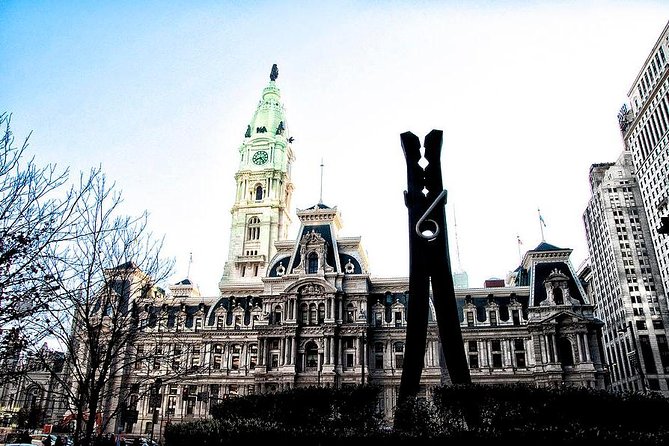
Then comes Congress Hall, another essential capital-era building. It hosted presidential inaugurations (Washington and Adams) and served as the home of U.S. Congress during the same 1790 to 1800 capital period. Even from outside, it helps you picture how often the young government had to operate under pressure, with legitimacy still being argued and built.
Franklin Court and the First Pentagon location: strategy plus inventions

The tour’s Franklin-focused segment keeps the story from feeling like it is only about speeches and signatures. At Franklin Court, you learn how Benjamin Franklin fit into the era of the Constitutional Convention and you hear the famous line about hanging together, tied to the revolution against the British crown.
From there, you visit the location of America’s first “Pentagon,” where military strategy and intelligence were formulated during the American Revolution. That is a great reminder that the revolution was not just battles. It depended on planning, information, and coordination.
If you like when a tour teaches you how people actually thought, this part delivers. Franklin becomes more than a monument name, and the “Pentagon” reference nudges you to see intelligence work as an early system, not a modern invention.
The Benjamin Franklin Post Office Museum: daily life in a revolutionary frame
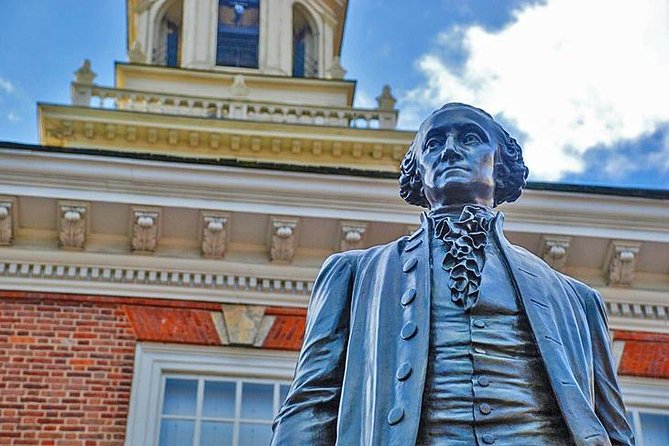
One of the most distinctive stops is the Benjamin Franklin Post Office and Museum. This is described as the only Colonial-themed post office operated by the USPS, and you get a living portrayal of colonial lifestyle rather than only static displays.
A detail I like for its straight-to-the-point charm: the post office does not fly the American flag there because it says there was not yet one in 1775 when Franklin was appointed Postmaster General. The postmark B. Free Franklin is still used to cancel stamps, which makes the history feel oddly current.
In the museum portion (on site, including the second-floor displays), you get postal history and memorabilia. If you want something beyond big civic buildings, this stop is a strong mid-tour reset. It gives you a sense of how communications moved, how the revolution connected distant places, and how Franklin helped shape systems the new nation needed.
Carpenters’ Hall and the French support thread
At Carpenters’ Hall, you land on the First Continental Congress site in 1774. This stop matters because it shifts the tour from declarations to negotiations, alliances, and the hard work of getting everyone aligned.
The tour describes secret meetings in December 1775 involving Franklin and figures including John Jay, Fancis Daymon, and the French spy Julien Achard de Bonvouloir. The core point is clear: the colonies likely would not have been able to win without French aid, and these meetings helped lead to negotiations for that support.
You also hear that British forces occupying the American capital later in the war occupied this building. That adds a darker, sharper edge. It makes the founding-era story feel less like a clean timeline and more like a struggle with consequences.
First Bank and Second Bank: Hamilton, Jackson, and the money storyline
After Carpenters’ Hall, the route turns toward institutions, starting with the First Bank of the United States. Championed by Alexander Hamilton, it was founded in 1797, and the tour includes a note about its significance for architectural design.
Then you continue to the area tied to the Second Bank of the United States, chartered by President James Madison in 1816 and losing its charter under Andrew Jackson in 1834. This is another way the tour teaches context: independence had to become governance, and governance runs on finance.
The guide ties in Hamilton and Jackson directly, including mentions of famous duels fought by both men. Even if you only know the names, the way these stops are arranged makes the early financial system feel connected to political power, not just economics.
America’s early “thinkers” and learning institutions: Philosophical Society and Library Company
The walk continues past the American Philosophical Society, founded by Franklin in 1743. The tour emphasizes that it was closely tied to the University of Pennsylvania, and it name-drops early members including George Washington, John Adams, Thomas Jefferson, Alexander Hamilton, Thomas Paine, and others.
The point here is not to memorize a list. It is to understand that the revolution’s leaders were also part of an intellectual network. Franklin and others pushed ideas forward in scientific and civic circles, which helped build credibility for the new nation’s direction.
You also visit the Library Company, founded by Franklin in 1731, described as the first institution in the world to lend materials to members of the public. Again, this is the kind of fact that changes how you see the city. It turns Philadelphia from a place of heroic moments into a place where practical learning and access mattered.
Dolley Madison’s house: the middle-class side of founding Philadelphia
A nice tonal shift comes with the Dolley Todd House site. The tour places it in 1791 to 1793, when Dolley Madison lived there with her first husband, John Todd.
The description focuses on what that home represents: a glimpse into the lifestyle of middle-class Philadelphia in the 18th century. It is a smart addition because it reminds you that the revolution was lived by more than politicians and generals. Families had to keep going, too.
Price and value: is $29 fair for what you get?
At $29 per person for about two hours, this tour sits in a sweet spot for first-time visitors. You pay for a guided route that bundles multiple anchor sites in one concentrated block, plus a guide who can explain what you see instead of just pointing at it.
You also get a built-in “plan your day” payoff. After the tour, you have a clearer sense of what to revisit, what to research further, and where you might want longer independent time inside major sites like Independence Hall if you want more than a quick highlight moment.
The small group cap (maximum 24) is part of that value. It helps maintain the walking pace and supports Q and A without turning into a herd.
Who should book this tour, and who might feel the friction
This is a great match if you want an efficient orientation to revolutionary Philadelphia and you enjoy guides who turn history into scenes. The guide descriptions in the available info strongly suggest that performance and storytelling are part of the brand, with examples like Josh, Kyle, Ted, Joseph, and Vince earning high marks for engagement and energy.
It is also a good choice for couples and families who want to keep moving and stay active, not just sit in one place. The walking format generally works better when your group is comfortable with cold streets and standing around landmarks for short bursts.
If you dislike standing outside for long stretches, cold weather can feel harder here. And if you expect a guaranteed deep interior experience at major buildings, you will want to plan your own follow-up time, especially for places that require timed entry passes.
Should you book Revolution and the Founders in Philadelphia?
Yes, I think you should book this tour if your goal is to understand the founding story quickly and in human terms. It gives you a well-paced route with major stops like the Liberty Bell and Independence Hall, then adds the Franklin layer and the institutional side of nation-building that many quick tours skip.
I would also book it if you want a starting point for the rest of your trip. You’ll leave knowing what to prioritize next, and you can pick your own time for interiors and museums where you want more depth.
Skip it only if you want a long, slow, sit-down style experience, or you want guaranteed inside access to multiple major sites beyond what timed passes and short highlight visits make possible.
FAQ
How long is the Revolution and the Founders history tour?
It runs for about 2 hours (approx.).
What does it cost per person?
The price is $29.00 per person.
Is this a small group tour?
Yes. The tour has a maximum of 24 travelers.
Do I need timed entry passes for Independence Hall?
Yes. Independence Hall requires free timed entry passes, and the tour provides clear instructions for navigating the complex.
Is the Liberty Bell pavilion interior included?
No. The interior of the Liberty Bell pavilion is not included, though you can get clear directions if you choose to invest additional time.
Does the tour run rain or shine?
It is described as running every morning and every afternoon rain or shine. It also notes the experience requires good weather.
Can I choose a morning or afternoon tour?
Yes. You can choose either a morning or afternoon tour depending on your schedule.
What is the cancellation policy for a full refund?
You can cancel for a full refund up to 24 hours in advance. If you cancel less than 24 hours before the experience starts, it is not refunded.
Newest Philadelphia reviews on the site
- Philadelphia: Double-Decker Hop-on Hop-off Sightseeing Tour★ 4.4 · 868 reviews
- Philadelphia: Revolution and The Founders History Tour★ 4.6 · 450 reviews
- Philadelphia: History, Highlights & Revolution Walking Tour★ 4.9 · 317 reviews
- Philadelphia: Double-Decker Sightseeing Bus Tour★ 4.2 · 332 reviews
- Philadelphia: Museum of Illusions Timed Entrance Ticket★ 4.2 · 244 reviews
- Philadelphia: Grim, Dark, and Twisted History Tour★ 4.6 · 231 reviews
- Double Decker Hop-On Hop-Off City Sightseeing Philadelphia (1, 2, or 3-Day)★ 4.0 · 562 reviews
- Philadelphia Old City Historic Walking Tour with 10+ Top Sites★ 5.0 · 2,020 reviews
Philadelphia Tours, compared.

Philadelphia Old City Historic Walking Tour with 10+ Top Sites
Read our review →
Double Decker Hop-On Hop-Off City Sightseeing Philadelphia (1, 2, or 3-Day)
Read our review →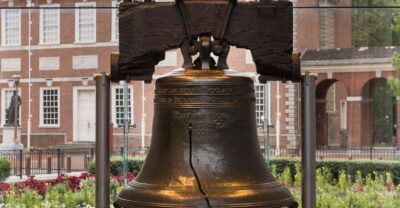
Browse the lists this tour appears in