
Reviewed · WASHINGTON DC TOURS
Discounted DC Night Tour With Magic LED- Snacks, LED Bracelets
Nighttime DC is powerfully easy to follow. This 3.5-hour tour strings together the big landmarks, and I love that the earpieces make every stop’s story clear, plus the LED bracelets help your group stay together after dark. Just note the White House visit is exterior only, since the interior is not open to the public.
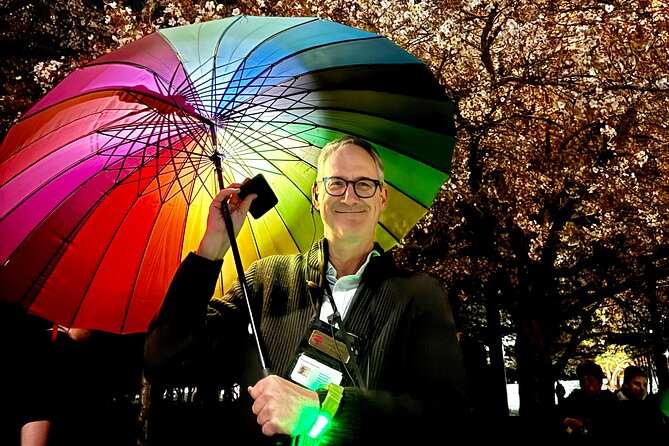
You also get that rare combo of comfort and confidence: a smooth, luxury bus ride, quick stops for photos, and enough guide talk that you do not feel like you are just drifting from statue to statue. In particular, guides like David and Larry set the tone with lively, detailed commentary, and the headsets mean you can look around without losing the thread.
One more practical consideration: some days swap in either the Korean War Veterans Memorial or the Marine Corps War Memorial, so your exact final-minute stop can depend on what day you go.
In This Review
- Key highlights worth planning around
- A 7:00 pm DC night route that does not waste your time
- Earpieces and LED bracelets: the upgrade you feel instantly
- The bus comfort that makes the whole evening work
- White House exterior: the famous façade and what you can read into it
- US Capitol and the dome moment
- The World War II Memorial: pillars, arches, and reflection time
- Cherry trees and festival traditions along the way
- Jefferson Memorial: quotes you can actually read
- Martin Luther King Jr. Memorial and the Stone of Hope
- Lincoln Memorial: the Civil War backdrop and the Dream speech context
- Korean War Veterans Memorial swap (depends on the day)
- Vietnam Veterans Memorial and the moment to pause
- Marine Corps War Memorial: Iwo Jima inspiration and short timing
- What it is like overall: pace, group size, and photo strategy
- Weather, clothing, and your comfort checklist
- How the tour delivers value for $52
- Should you book this DC night tour?
Key highlights worth planning around
- Earpieces for clear listening so you can hear directions even when you drift for photos
- Glow-in-sync LED bracelets that make it easy to find your group in the dark
- Major DC monuments lit up at night from the White House area across the National Mall
- Simple included comfort like a bottle of water and a light snack during the ride
- Day-specific memorial swaps for the Korean War and Marines stops
- Focused timing at each stop around 10 to 20 minutes to keep the route moving
A 7:00 pm DC night route that does not waste your time
This is a classic “DC at night” format done the smart way. You start at 7:00 pm near McPherson Square Station (I St NW) and head out by bus, with frequent photo-and-stroll stops that keep the pace lively but not frantic. You end back at the same meeting point, which is a nice stress reducer when you are tired, it is late, and the metro feels like a maze.
The big reason I like this kind of tour is simple: DC’s scale can trick you. Distances look manageable in daylight, then you turn around at 8:30 pm and realize you have walked a long way. This route solves that by combining driving between clusters with short time on foot, so you still get the illuminated views without committing to a full evening of long walks.
At $52 per person for about 3 hours 30 minutes, the price is not just about “seeing monuments.” You are also paying for transportation, a professional guide, and the included tech that makes night touring actually workable, the earpieces and the LED bracelets. If you tried to do this solo, you would spend time figuring out parking or transit moves, then lose the guided context that makes the monuments more than pretty lights.
Other Washington DC outings to compare
- DC Memorials Night Tour: Glass-Roof Convertible Upgrade Option
★ 4.5 · 6,933 reviews - National Mall Monuments Night Tour with 10+ Stops, Entry Tickets
★ 4.5 · 4,863 reviews - National Mall Night Tour with 10+ Monuments (Public or Private)
★ 4.5 · 2,207 reviews
Earpieces and LED bracelets: the upgrade you feel instantly
Night touring is usually about two things: visibility and communication. This tour’s best trick is that it tackles both.
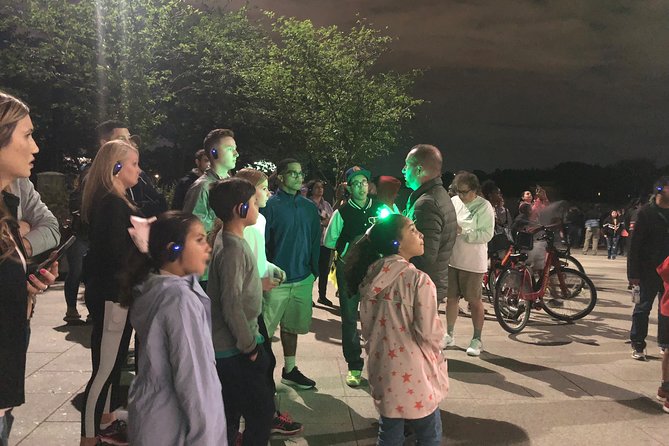
The earpieces let you hear your guide clearly as the driver drops you off and you wander a bit for pictures. This matters because many of the stops are spread out just enough that you do not want to stay glued to the front of the group the whole time. With the headset, you can step aside, frame your shot, and still catch the next story. People raved about how well this works, including when guides like David were talking and you were not standing right next to them.
Then there are the LED bracelets, which glow in sync. When it gets dark and people naturally fan out, they make it fast to reassemble. In practice, you spend less time scanning faces or backtracking just to find your group, and more time actually enjoying the monuments. If you have ever tried to meet up in a crowd after dark, you know why this is a big deal.
The bus comfort that makes the whole evening work
The ride is part of the experience here. You get luxury and comfortable transportation, and the bus experience is repeatedly praised as smooth, with air conditioning noted on hot nights. That sounds small until you remember the route is in the evening, and DC weather can be unpredictable. When you are not fighting heat or cramped seating, you arrive at the monuments still ready to look up and pay attention.
Also, the tour runs with a max group size of 55 travelers. That is not tiny, but it is small enough that your guide can keep the flow organized during stops. Several guides were praised for staying attentive, and that usually only happens when the group is manageable.
White House exterior: the famous façade and what you can read into it
You start at the White House area for about 20 minutes, and yes, you only see the exterior. The listing is clear on this point: the interior is not open to the public on this visit, so plan your expectation accordingly. The upside is that you are not stuck waiting for a restricted-access opportunity that would derail a timed night route.
Even from outside, there is a lot to notice once someone points it out. Your storyteller guide talks as you look at the building, and you get context for why this place matters beyond the obvious headline associations. Since it has stood since 1800, the White House is not just a symbol, it is a time marker for how the presidency and the country evolved.
Practical tip: treat this stop like a photo briefing. Take your classic shots, then let your guide’s story shape what you notice next across the city.
Same corner of the map, another day out:
- Washington DC Monuments by Moonlight Tour by Trolley
★ 4.5 · 3,956 reviews - Hop-on Hop-off Sightseeing Tour by Open-top Bus with 18 Stops
★ 3.5 · 3,848 reviews - Washington DC in One Day: Guided Sightseeing Tour
★ 4.5 · 3,360 reviews - DC Monuments and Capitol Hill Tour by Electric Cart
★ 5.0 · 2,841 reviews
US Capitol and the dome moment
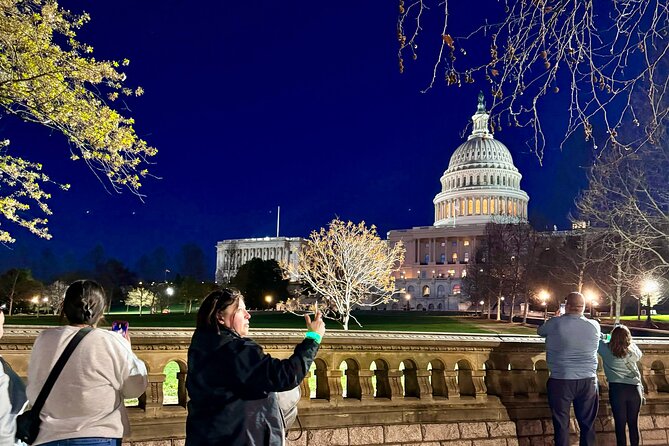
Next up is the U.S. Capitol for about 20 minutes. The focus here is the role of the Capitol as the meeting place of Congress, plus the dome as an architectural landmark. Admission is listed as free, which helps you spend your time looking rather than worrying about tickets for this specific stop.
This is also a good stop for comprehension. When you see the Capitol at night, it is easy to think of it as just another government building. With the guide’s narration, you start to connect it to what Congress does and why the architecture and layout carry meaning.
If you are into photography, aim to take a wide shot first, then walk around for perspective. Night lighting can exaggerate scale, and your perspective will help you avoid “I saw it, but I cannot picture it” syndrome later.
The World War II Memorial: pillars, arches, and reflection time

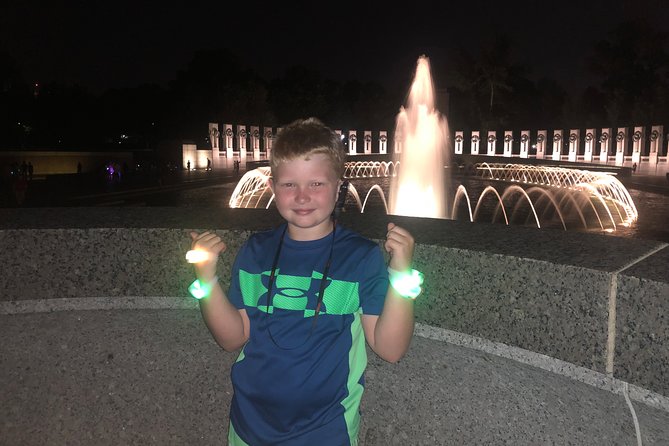
You move on to the National World War II Memorial for around 15 minutes. This stop has some very specific elements that make the place easy to follow while you listen: it honors 16 million Americans who served during World War II, and the design includes 56 pillars and two triumphal arches, plus a serene fountain for reflection.
At night, the symmetry hits differently. Pillars become a visual rhythm, and the arches give you those frame-ready silhouettes. The time here is short, but it is enough if you split your minutes into two modes: look first, then absorb. The fountain area gives you a moment to slow down, even on a fast-moving tour.
Admission is free, so again, this is about seeing and hearing rather than budgeting for tickets.
Cherry trees and festival traditions along the way

There is also a stop to share history tied to cherry trees and cherry Blossom festival traditions. This is one of those “don’t expect a museum, expect a story” moments. It gives you cultural context that helps explain why DC does what it does when the blossoms arrive.
Even if you are visiting outside peak bloom, this kind of stop helps you understand the city’s seasonal identity. It is also a nice shift from pure monuments to something more about traditions and community rhythms.
Jefferson Memorial: quotes you can actually read
The Jefferson Memorial gets about 20 minutes. It is dedicated to Thomas Jefferson, tied to his authorship of the Declaration of Independence, and shaped by his interests in architecture, philosophy, and democracy. The best part for most people is that the memorial includes famous quotes inscribed around the space, and the tour encourages you to take a moment to read them.
At night, reading can be a challenge if the lighting feels dim for your eyes. Still, the stop’s value is that your guide frames what to look for, and you spend more time with the meaning than you would on a quick photo lap.
Admission is free, so you can treat this stop as a pause and a reset, especially if your feet are starting to feel it.
Martin Luther King Jr. Memorial and the Stone of Hope
The Martin Luther King, Jr. Memorial is about 15 minutes. It celebrates his fight for equality, justice, and civil rights, with the Stone of Hope highlighted as a key element. This is a stop where the night lighting can feel solemn, not just scenic, and that tone matters.
You are not rushed through. The short time window still leaves room to notice what the memorial is designed to communicate. If you have ever seen images of MLK in speeches and statues, this stop translates that into a physical space that’s meant for reflection.
Admission is free, so the only “cost” here is time and attention, which is exactly what a night tour should encourage.
Lincoln Memorial: the Civil War backdrop and the Dream speech context
You then get about 20 minutes at the Lincoln Memorial. It is described as watching over the National Mall, and the narrative connects Lincoln’s leadership during the Civil War to the memorial’s role in the Civil Rights Movement, including Martin Luther King Jr.’s I Have a Dream speech.
This is one of those landmark-to-meaning bridges. When you stand there at night, the building feels permanent and mythic, but the guide’s story pulls it back into timeline reality. That makes the stop more than postcard territory.
Admission is free, which lets you focus on the guide and your surroundings rather than logistics.
Korean War Veterans Memorial swap (depends on the day)
The route includes the Korean War Veterans Memorial for 10 minutes, but it runs on Monday, Wednesday, Friday, and Sunday. Admission is listed as not included, which matters if you were hoping everything would be fully covered. The tour also notes that you can coordinate with your guide to go to the Korean War Memorial instead of taking more time at Lincoln.
This is actually useful for you. If you care more about the Korean War segment, you can lean into it. If you prefer Lincoln and want a longer moment there, you can likely adjust with your guide’s guidance.
The key is that you should expect slight variations in the schedule depending on day. That is not a problem, it is part of how tours handle permits, access, and timing around memorials.
Vietnam Veterans Memorial and the moment to pause
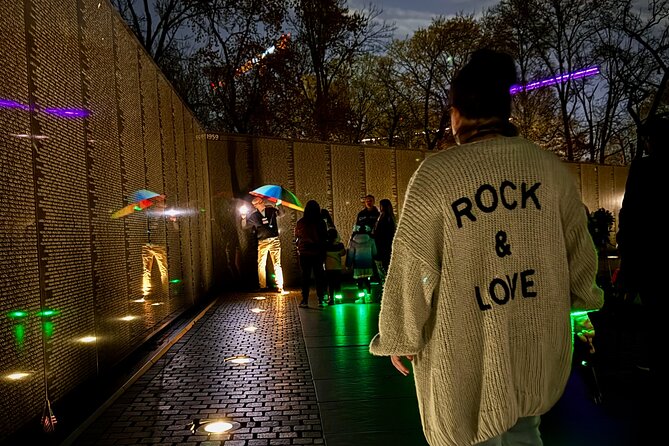
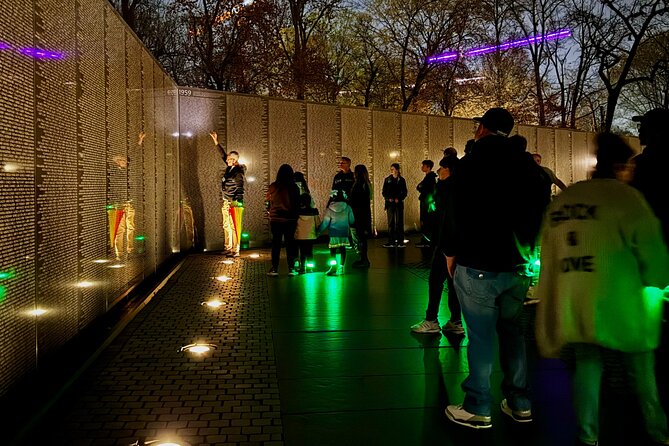
The Vietnam Veterans Memorial is about 15 minutes, and admission is listed as free. The tour’s framing here is straightforward: it pays tribute to the brave members of the U.S. Armed Forces who fought in the Vietnam War. In a night setting, this stop can feel especially heavy, because the lights do not change the emotional tone.
Give this one a full couple of minutes of quiet scanning. Let the guide’s direction help you know where to look, then let your eyes do the work. This is a stop where “fast and scenic” misses the point.
Marine Corps War Memorial: Iwo Jima inspiration and short timing
Finally, you may visit the U.S. Marine Corps War Memorial for about 10 minutes, depending on the day. It is listed for Tuesday, Thursday, and Saturday. This memorial is also known as the Marine Corps War Memorial, and the design is based on the iconic Iwo Jima photograph of soldiers raising the flag during World War II.
Admission is free for this stop. It is a quick hit, so your guide’s framing matters. The statue captures a specific moment of triumph and bravery, and at night the lighting helps the sculpture read clearly.
If you are a history buff, this is a good closer because it ties a WWII visual to the Marine legacy in a way that feels concrete.
What it is like overall: pace, group size, and photo strategy
Across the evening, the stop timing is built to keep you moving: roughly 10 to 20 minutes per site. That can feel short if you love slow wandering. But for a first DC visit, it is a smart format. You see the big players on the National Mall without spending your whole night trying to navigate between landmarks.
Your best strategy is to use the headset zones well. Listen first for the “what to notice” cues, then take your photos in the moments that matter. The LED bracelets make it easier to wander for a picture, but you do still want to check back quickly so you do not lose the rhythm of the route.
If you visit with family, this tour can be a solid learning loop. A number of school-age travelers enjoyed it for exactly that reason, the guide stories and the audio clarity help kids stay engaged rather than tune out.
Weather, clothing, and your comfort checklist
Night air can change fast in DC. Bring a light layer even if it feels warm when you start. If you are going in hot season, you have the comfort of the air-conditioned bus, but you still will be outside for multiple short memorial walks.
Also, keep your phone battery in mind. You will want it for photos, and you will be outside, using lights and camera apps. The tour tech is provided, but it does not charge your devices.
Finally, wear shoes you can move in. You are not doing an all-day hike, but you are doing several short walks, and memorial terrain can include ramps, steps, and uneven spots.
How the tour delivers value for $52
Here is the value math in real terms. For $52, you get:
- guided stories across major DC landmarks at night
- transportation for the between-stop travel
- earpieces so you do not miss the narration
- LED bracelets so you can find your group easily
- a bottle of water and a light snack
The value is strongest for first-timers and for people who want context without a full-day commitment. If you already know DC well and only want photos, you might decide you do not need the guide or the earpieces. But for most visitors, especially those doing other daytime plans, this night route is a high-leverage use of time.
One small note: the White House stop is exterior only, and some elements like the White House and Korean War Veterans Memorial are listed as not having included admission. That does not hurt the experience, but it does affect what you can expect to access, so go in ready for “see the area and learn” rather than “tour inside.”
Should you book this DC night tour?
Book it if you want a simple way to see the National Mall’s biggest names lit up, while still understanding what you are looking at. The combination of earpieces and LED bracelets is the difference between a tour you enjoy and one you tolerate, and guides like David and Larry show up as the kind of storyteller you can actually follow even while you move around.
Skip it or reconsider if you only want interior access, because the White House is exterior only on this format, and the tour’s strength is narration plus quick nighttime viewing. Also, if you are the type who hates group timing and prefers long unstructured wandering, you might find the stop windows a bit tight.
If you are flexible and you want an efficient, night-lit overview of DC with real guidance, this is a very reasonable way to start your trip.
Newest Washington DC reviews on the site
- DC: White House, National Mall and Lincoln Memorial Tour★ 4.1 · 279 reviews
- DC: Capitol and Library of Congress Guided Small-Group Tour★ 4.6 · 261 reviews
- Washington DC: Monuments and Memorials Bike Tour★ 4.8 · 399 reviews
- Washington DC: Sightseeing Tour with Potomac River Cruise★ 4.7 · 311 reviews
- Washington DC: National Mall Tour by Electric Vehicle★ 4.8 · 1,206 reviews
- Washington DC: Monuments by Night Bike Tour★ 4.3 · 254 reviews
- Washington DC: Night Tour with 10+ Stops, Admission Tickets★ 4.6 · 286 reviews
- DC: Capitol Hill and Library of Congress Tour with Tickets★ 4.7 · 1,125 reviews
Washington DC Tours, compared.
DC Memorials Night Tour: Glass-Roof Convertible Upgrade Option
Read our review →
National Mall Monuments Night Tour with 10+ Stops, Entry Tickets
Read our review →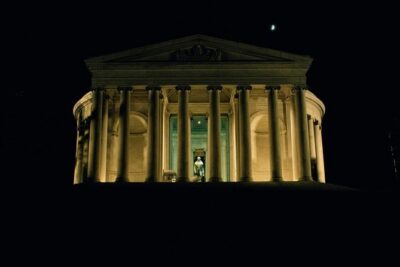
Washington DC Monuments by Moonlight Tour by Trolley
Read our review →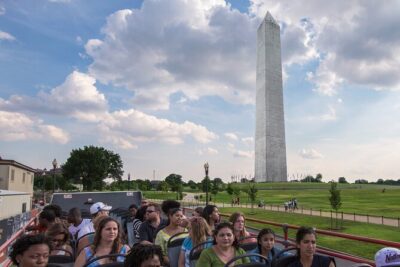
Hop-on Hop-off Sightseeing Tour by Open-top Bus with 18 Stops
Read our review →
Washington DC in One Day: Guided Sightseeing Tour
Read our review →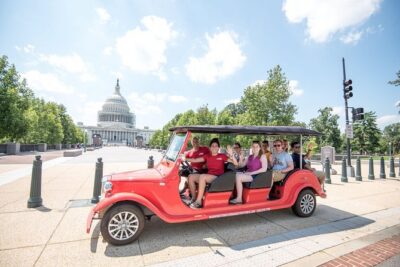
DC Monuments and Capitol Hill Tour by Electric Cart
Read our review →
Washington DC Moonlight Tour by Electric Cart
Read our review →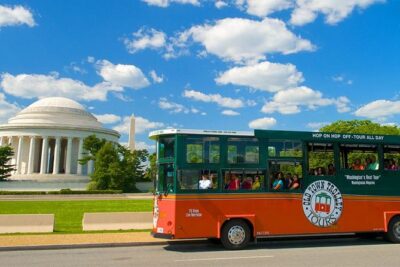
Washington DC Hop-On Hop-off Trolley Tour with 15 Stops
Read our review →Browse the lists this tour appears in